
B2B Sales Prospecting Checklist
Use a 7-step B2B sales prospecting checklist to turn ICP criteria into a smaller prospect list, score fit and timing, and write a first touch from one clear reason.


B2B sales prospecting starts with a smaller list
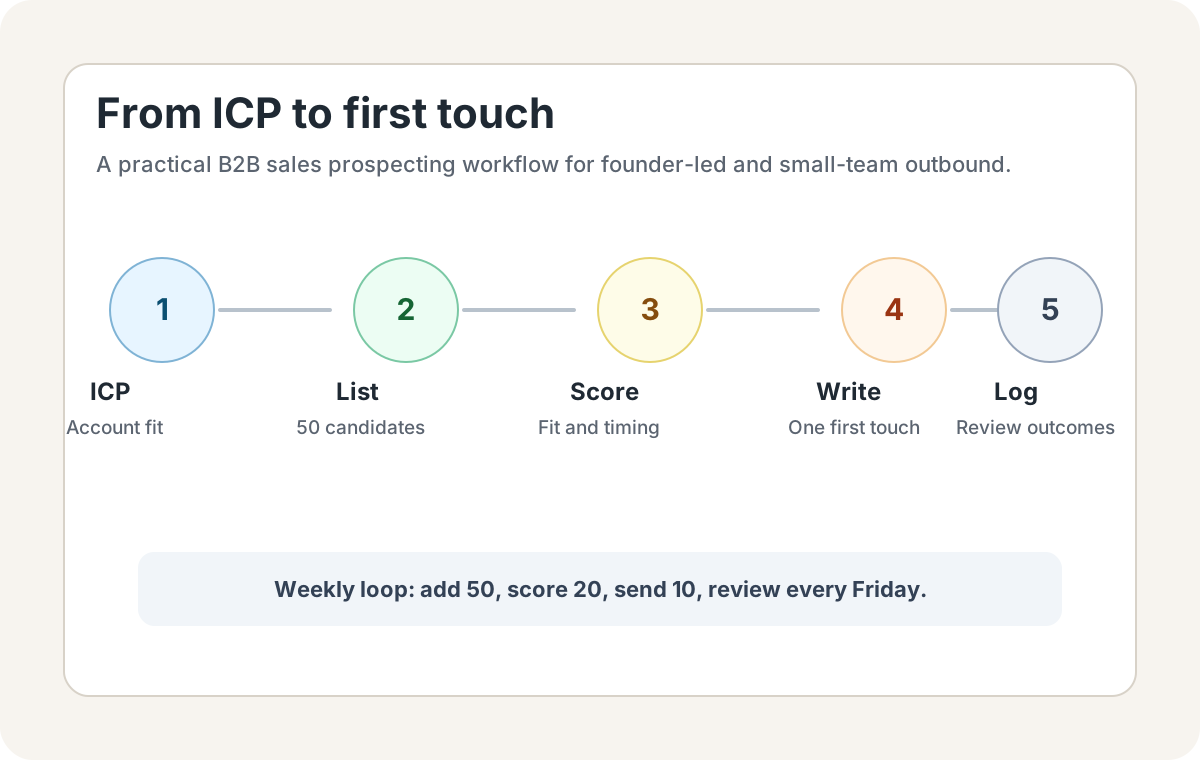
B2B sales prospecting works when you stop treating every company as a possible buyer. Start with 50 account candidates, score the best 20, and send only the 10 where fit, timing, and context are strong enough. That rhythm keeps the work practical for a founder, RevOps lead, or small sales team that cannot afford noisy outreach.
The job is simple, but the decisions are not. You need to choose which accounts deserve attention, which people inside those accounts matter, and which reason gives you permission to write now. Use this checklist before you spend time on email copy, phone prep, enrichment, or LinkedIn research.
If you already have a broad routine, treat this page as the quality gate. If you are starting from scratch, use the seven steps in order. Each step should leave you with a clearer send, revise, or reject decision. A prospect that cannot pass the score should not enter outreach.
The evidence behind a stricter quality gate
RAIN Group reports that 82% of buyers accept meetings with sellers who reach out, but that does not mean every account should be messaged. The strongest prospecting systems combine early outreach with clear account fit, a relevant buyer, and a timely reason to write.
The B2B prospecting numbers to plan around
Modern buyers do more work before sales joins the conversation. 6sense research says buyers complete about 70% of the buying journey before speaking with sellers, and buyers initiated first contact 83% of the time in the same study. That makes relevance the first conversion lever, not copy length.
Gartner found that 73% of B2B buyers actively avoid suppliers that send irrelevant outreach. In a later Gartner survey, 67% of buyers preferred a rep-free buying experience. Those numbers do not argue against prospecting. They argue against sending before the account, buyer, signal, and question line up.
Use those numbers as guardrails. Your list can be smaller than a generic outbound playbook recommends. Your research should be stronger than a generic lead list allows. Your weekly review should ask whether the right people understood the reason for the message, not only whether a meeting was booked.
For this checklist, a good prospect is not just reachable. A good prospect has a visible business reason, a buyer who can act, and enough context for a specific first question. That definition keeps research tied to revenue work instead of list volume.
1. Define the ICP before you search
Your ideal customer profile should decide who enters the list before any channel tactic appears. Write down the account criteria that change your outreach decisions. For most B2B teams, that means industry, company size, geography, business model, current workflow, team structure, and exclusion rules.
- Keep 5 to 8 account fields that a real person can check in under 3 minutes.
- Add 2 to 4 exclusion rules, such as too small, too enterprise, wrong geography, or agency model.
- Separate account fit from buyer persona fit so the right title at the wrong company does not sneak through.
A vague ICP creates list debt. You pay for it later with weak personalization, messy CRM fields, and follow-ups to people who were never realistic buyers. A narrow ICP makes the rest of the B2B sales prospecting process faster.
Use a plain review rule. If another person on your team cannot apply the ICP without asking you what it means, the ICP is not ready for prospecting. Rewrite vague fields such as mid-market SaaS or growth companies into observable checks before you search. Better fields include revenue band, team size, hiring pattern, tech stack, region, and role ownership.
Reject weak accounts before they create copy problems
A weak ICP does not only waste research time. It forces every later step to compensate for missing fit. That is why this checklist rejects accounts early, even when the title looks promising.
2. Build a prospect list from account evidence
A B2B prospect list is not a scrape of every matching title. It is a reviewable queue of accounts that look close enough to investigate. Start with account evidence, then find people. This prevents the common mistake of falling in love with a title before the company is worth your time.
Use three source types. Customer clones give you the strongest fit pattern. Trigger searches give you timing, such as hiring, funding, new leadership, expansion, or product launches. Community and social activity can reveal pain language that does not show up in static datasets.
Keep the first list deliberately small. A 50-account candidate list is large enough to show patterns and small enough to review by hand. If 40 of those accounts fail the score, you learned that your search inputs are too broad before you wasted outreach capacity.
- Add 50 account candidates to a sheet or CRM view.
- Reject any account with 2 or more missing ICP fields.
- Keep only the 20 accounts where you can name a likely reason to care.
Do not enrich every account immediately. First, mark why the account entered the list. Use short labels such as hiring sales reps, entering a new market, migrating systems, adding a department, or showing repeated public activity around the problem you solve. Those labels make later review possible.
A good list has enough evidence to remove an account without regret. If the only reason an account appears is that it matches a broad industry filter, move it back to research. Prospecting quality improves when the list keeps a visible trail from search input to send decision.
3. Pick the buyer and backup contact
The best account still fails if you write to the wrong person. For each ready account, choose one primary buyer and one backup contact. The primary buyer should own the problem or budget. The backup should influence the workflow or know who owns it.
Do not rely on seniority alone. A founder, VP, head of sales, RevOps lead, or operations manager may all be valid depending on the problem. The test is whether the person would recognize the pain in 10 seconds and have a reason to answer.
For complex accounts, add a second contact before outreach begins. The backup is not there for volume. The backup helps you avoid a dead end when the first person is adjacent to the problem but not close enough to own the next step.
Write down the buyer logic in one sentence. For example, the head of sales owns the pipeline gap, while RevOps owns the workflow data. That sentence keeps your first message specific and helps you avoid generic job-title assumptions.
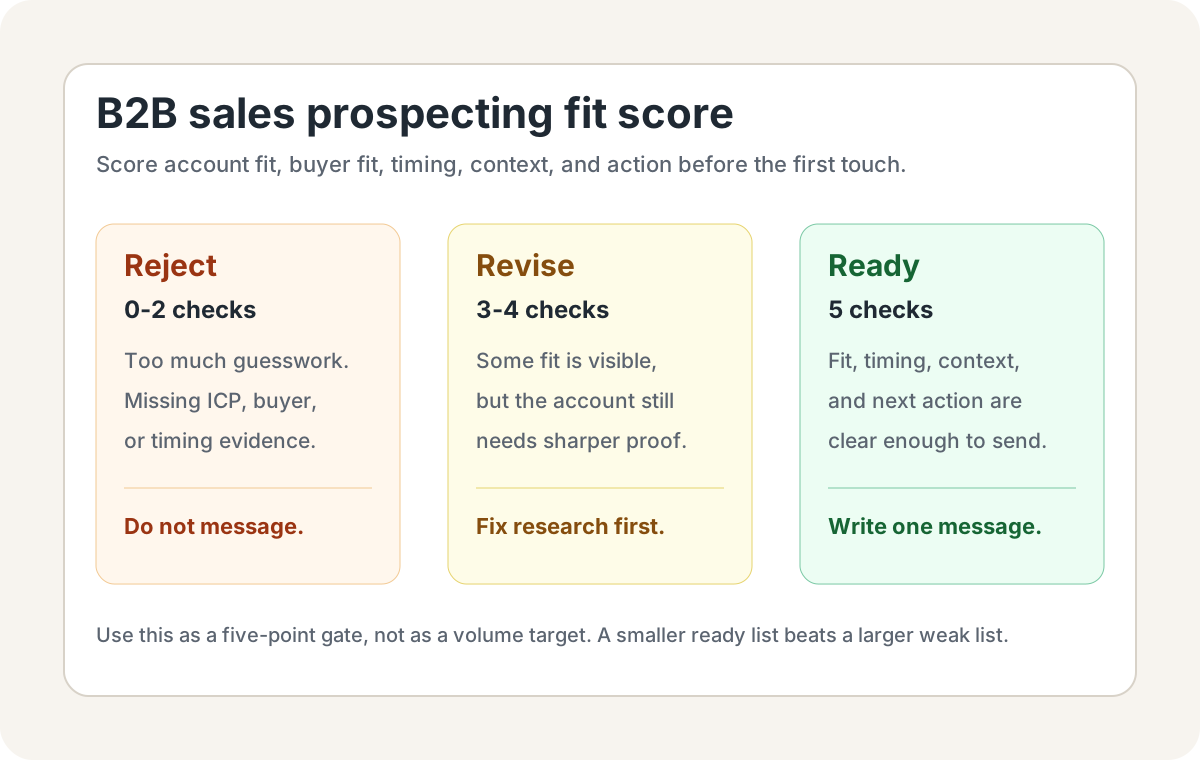
B2B sales prospecting scorecard
Use this scorecard before a name enters your first-touch queue. The goal is to protect message quality by rejecting weak accounts early.
4. Score fit and timing before writing
Score every prospect before you write the first touch. Use five checks. Account fit, buyer fit, problem fit, timing signal, and context line. Send only when all five are present. Revise at three or four. Reject at two or below.
This score protects message quality. A weak prospect forces you to write around missing context. A strong prospect lets you write a short message with one real reason, one relevant pain, and one easy question.
- Account fit means the company matches your ICP fields.
- Buyer fit means the person owns or strongly influences the problem.
- Problem fit means your offer plausibly connects to a visible workflow or constraint.
- Timing means there is a recent reason to write now instead of later.
- Context means you can explain the relevance in one sentence.
The score should be strict because buyers penalize irrelevant outreach quickly. A prospect with account fit but no timing is not ready. A buyer with the right title but no visible problem is not ready. A signal with no clear owner is not ready.
The 5-check scoring rule
Send only at 5 of 5. Revise at 3 or 4. Reject at 2 or below. This makes the quality standard easy to audit and keeps small teams from sending because a list is full.
5. Choose the channel from the signal
Do not choose the channel from habit. Choose it from the signal. A website change or hiring page may fit email. A direct post or comment may fit a LinkedIn touch. A referral path may fit an introduction. A high-value account with clear urgency may justify a call.
This keeps B2B lead prospecting human. You are not trying to run every channel at once. You are choosing the first touch that makes the signal easiest to understand. The follow-up channel can change after the first attempt.
Document the reason for the channel choice in one short note. For example, use email because the signal came from a hiring page, or use LinkedIn because the person posted about the exact workflow. That note helps you review later whether the channel matched the evidence.
- Use email when the signal is account-level and easy to explain in writing.
- Use LinkedIn when the signal came from public activity by the person.
- Use a referral when trust is more important than speed.
- Use a call when the account value and timing justify higher interruption.
Channel choice should reduce friction for the buyer. If the signal came from a public post, referencing that context in a short social touch feels natural. If the signal came from hiring or a website change, email often gives enough room to connect the change to a business problem.
6. Write one message from one reason
The first message should be short because the prospect has not asked for a pitch. Use one context line, one problem hypothesis, and one low-friction question. Keep the first touch under 90 words for email or under 300 characters for a connection note.
A useful opener might name the account change, the likely workflow pressure, and the question you want answered. Avoid stacking three signals. Multiple signals often feel impressive to the sender and intrusive to the buyer.
- Context line, why this account or person.
- Problem hypothesis, what might be happening.
- Question, what small answer would move the conversation forward.
Do not mention every piece of research you found. One reason is usually clearer than three. A crowded message can feel like surveillance, while a single relevant reason gives the buyer a clean path to answer.
A useful question asks for a correction or a next pointer. Try asking whether the problem sits with their team, whether the timing is relevant, or whether there is a better owner. Avoid asking for a full demo meeting in the first sentence.
7. Review outcomes every week
B2B prospecting methods only improve when you review the outcomes. Once a week, check how many candidates entered the list, how many passed the score, how many first touches went out, and which replies were useful. The first useful benchmark is not meetings. It is whether the right people are answering at all.
A practical weekly loop is simple. Add 50 candidates, score 20, send 10, and review every Friday. If replies are irrelevant, tighten the ICP. If replies say the timing is wrong, improve signals. If replies understand the problem but do not engage, improve the ask.
Track the reasons behind rejections too. If most candidates fail account fit, your search inputs are too broad. If most fail buyer fit, your role assumptions are weak. If most fail timing, you need better signals before list building.
- Candidate count, how many accounts entered review.
- Pass rate, how many reached 5 of 5.
- Revision rate, how many stalled at 3 or 4.
- Useful reply rate, how many replies clarified the account or buyer.
- Learning note, what to change next week.
How this avoids common B2B prospecting mistakes
Most broad guides list channels, tools, and tactics. That is useful, but it can hide the core failure. Bad B2B sales prospecting usually starts before outreach. The list is too wide, the buyer is assumed, the timing is weak, or the message tries to compensate for poor research.
This checklist puts the reject decision earlier. You should reject more prospects than you message. That is not wasted work. It is how a small team keeps outbound relevant while larger competitors chase volume.
The practical advantage is not that the article is longer. The advantage is that each section produces an auditable decision. A teammate can open the list, see why an account was included, check the five criteria, and understand why the message should or should not be sent.
That makes the process easier to improve. You can inspect failed accounts without debating taste. You can compare useful replies against the original score. You can also pause a channel without losing the underlying account research.
Sources
RAIN Group sales prospecting statistics for buyer meeting acceptance and early-contact context.
6sense B2B buyer research for buying-journey timing and buyer-initiated contact findings.
Gartner 2025 B2B buyer survey for buyer avoidance of irrelevant outreach.
Gartner 2026 B2B buyer survey for the rep-free buying preference benchmark.
Frequently asked questions
B2B sales prospecting is the process of finding business accounts and people who fit your offer, then starting a relevant conversation. A useful process starts with ICP fit, checks buyer fit and timing, and only sends outreach when there is a clear reason to write.
Start with account criteria, not job titles. Add 50 account candidates, reject accounts with missing ICP fields, then choose contacts only inside the strongest accounts. This keeps your list smaller, easier to review, and more useful for personalized outreach.
A good B2B prospect matches your ICP, has a relevant buyer or influencer, shows a plausible problem, and has a recent reason to care. If you cannot write one specific context line, the prospect needs more research or should be rejected.
A small team can start with 10 strong first touches per week. Add around 50 candidates, score the best 20, and contact only the 10 that pass fit, buyer, problem, timing, and context checks. Quality matters more than list size.
B2B prospecting is seller-led. You choose accounts and start conversations. Lead generation is usually marketing-led. It attracts or captures people who show interest. Both can feed pipeline, but prospecting gives you more control over which accounts enter the conversation.